
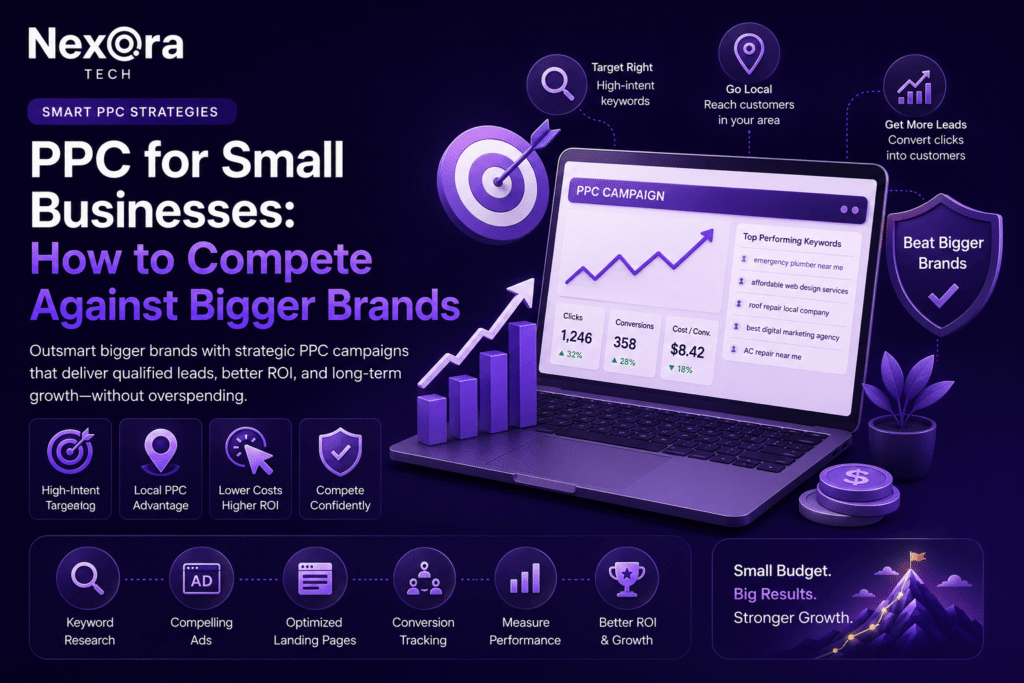





Going digital and selling online might be a scary experience especially if your small business is trying to compete against the big companies. Getting your business involved in PPC for Small Businesses via our PPC Services page is a great way for small businesses to find a very profitable segment market. Lots of local business owners have a hard time standing up to big companies who have large and almost unlimited marketing budgets.
But with the help of clever, quick, and well-focused tactics, your company will be able to find the right prospects, increase your returns on investment, and get first class visibility on search engine results pages without spending more than necessary.
Why PPC Gives Small Businesses a Competitive Advantage
Pay-per-click advertising is the great equalizer in the world of digital marketing. Properly optimized campaigns give small business websites the opportunity to be visible alongside big brand websites, or even higher than them, at the very moment a customer is ready to make a purchase.
How PPC Can Help Businesses Compete
In traditional advertising, the one with the biggest budget is always the winner. When it comes to paid search marketing, the amount of the bid and the relevance of the ad together determine a company’s visibility. If your ads are more aligned with a user’s search than your competitor’s generic corporate ads, Google may give your business the highest spot at a cheaper cost.
Advantages of PPC for Small Businesses
- Instant exposure: Unlike organic SEO which requires months, PPC advertising for small businesses starts driving traffic on the very first day your campaign is launched.
- Targeted Demographics: Ads show only to the users who are indicating that they have an intention to make a purchase.
- Comprehensive Budget Management: You have full control over how much money you want to spend per day, per click, and per region.
Common PPC Challenges Small Businesses Face
The possibilities of high ROI (return on investment) are quite significant, however, in order to securing your marketing capital, it is necessary to be very careful and effectively deal with certain difficulties.
Facing Large Advertising Budgets
Big brands can afford to bid very high for more general and high traffic keywords. For smaller businesses, desperate bidding on such terms will simply use up your daily budget very fast and there will be very little conversions to show for it.
Inadequate Marketing Resources and Know-How
It is not a simple task to keep multiple accounts up-to-date and run them smoothly. Besides, small business owners often are short of the necessary time for in-depth keyword research, conducting A/B split tests, and making bid adjustments on a regular basis.
Establishing Credibility in the Face of Well-Known Brands
Your advertisement copy is the only way you will be able to make a user trust your company within a split second and make him/her click if he/she sees your ad alongside a very popular brand name.
Target Long-Tail Keywords Bigger Brands Miss
One effective pay-per-click (PPC) strategy for small businesses is focusing on long-tail keywords. While big brands generally target broad categories, this can leave highly valuable niche phrases completely open.
Why Long-Tail Keywords Convert Better
Long-tail keywords are detailed phrases that show exactly what a customer wants. As these queries are specific, the searcher is typically very near to making a buying decision which leads to extremely better conversion rates.
Examples of High-Intent PPC Search Terms
Rather than competing on the costly and generic term “accounting software,” a local business could target “affordable QuickBooks setup services for medical practices” and similar phrases.
Finding Low-Competition Keyword Opportunities
Employ keyword research tools to single out terms with a low number of searches but extremely high buying intent. These less obvious options not only have a much lower cost per click (CPC), but this also means you can make your advertising money go a lot further.
Improve Quality Score and Lower Ad Costs
How to lower PPC costs for small business means you need to focus on learning one key metric: the Google Ads Quality Score.
What are the quality score factors for Google Ads?
Google assigns a grade to your keywords, ads, and landing pages on a scale of 1 to 10. This number is derived from the estimated click-through rate, the relevance of the ad, and the user’s experience on the landing page.
Getting better ad relevance throughout
Target keywords should be clearly repeated in your ad headlines and descriptions. This direct match shows the search engines that the business is offering exactly what the user wants.
How to lower cost per click with optimization
Quality Score is a factor in the price determination. A score of 8 or more may reduce your actual cost per click by up to 50%, which means your budget would be able to yield twice the website visits of a less optimized competitor.
Write PPC Ads That Generate More Clicks
Your ad copy is like a digital storefront window. It has to be captivating enough to make the user stop scrolling and click on your ad rather than the competitors’ ones.
Concentrating on Customer Issues and Solutions
Don’t write self-centered copy that only talks about your company’s history. Actually, start with the customer’s direct problem and offer them the solution right away. Emphasize the quickness, trustworthiness of the service, and transparent pricing schemes.
Developing Powerful CTAs That Bring Conversion
Don’t let the potential customer wonder what comes next. Give strong, clear commands with your words like “Get a Free Quote Today,” “Book Your Consultation,” or “Claim 10% Off Now.”
Trying Various Ad Versions for Maximum Efficacy
Never stop at one or two versions of responsive search ads only. Let the analysis show you which combinations of the headline bring the highest click-through rates and then systematically stop the assets that perform the lowest.
Track PPC Performance and Improve ROI
Making decisions based on data is what makes a profitable PPC management for small businesses.
Key PPC Metrics Every Business Should Track
- Cost Per Acquisition (CPA): The amount of ad spend necessary to convert one closed lead.
- Conversion Rate: The fraction of ad clicks that result in leads.
- Click-Through Rate (CTR): A metric of how persuasive your ad copy is to searchers.
Setting Up Accurate Conversion Tracking
Place powerful tracking codes throughout your site to keep an eye on form completions, live chats, and phone calls. Precise tracking informs your ad platform which keywords are producing sales so the system can automatically adjust your exposure for better performance.
Identifying and Eliminating Wasted Ad Spend
Analyze your search terms report each week to find out what expressions actually brought up your ads. In case you discover irrelevant searches, reject them at once in order to stop using your funds on traffic that doesn’t convert.
How Nexora Tech Helps Small Businesses Grow
Don’t worry about the complexities of digital advertising by yourself. Getting a top-notch PPC Advertising Company to work with you means you can rest assured that your funds will be used with the highest level of efficiency.
Tailor-made PPC Programs That Reflect Business Objectives
Here at Nexora Tech, we do not adhere to the traditional one-size-fits-all marketing. We develop highly specialized Google Ads for small businesses that correspond very well not only with your specific revenue targets but also with your service areas and the local market conditions.
Honest and Open Reporting with Full Performance Visibility
Transparency is one of our values. Our clients get comprehensive and straightforward reports that measure key indicators for business owners—potential customers, new clients, and overall investment return.
Flexible PPC Options for Every Budget Size
Our inexpensive PPC campaign support is laid out to function without any problems as you grow your business. Once your advertising starts making money, we carefully put the profit back into your business to make it grow even faster in the market.
Final Thoughts on Small Business PPC Success
Winning at paid search is, after all, a matter of having a strategy, being agile, and performing with accuracy, not just relying on making a big financial spend. Putting your money into very focused keyword targeting, setting up an efficient local PPC campaign, and working on the conversion rate of your landing pages are what make your business grow in a predictable manner.
Do you want to beat the competition, get the most out of your ad budget, and make your business really take off? Reach out to Nexora Tech to have a chat with a PPC Management for Small Businesses specialist who will help you get started with your very own program.
Frequently Asked Questions (FAQs)
How Much Should a Small Business Spend on PPC?
There is no one-size-fits-all minimum budget. That being said, many small businesses that are growing will generally start their advertising spend at a monthly ad spend of $1,000 to $3,000. And then, they will continue to change the volume dynamically based on the performance data and lead quality.
Is Google Ads Worth It for Small Businesses?
Yes, definitely. The reason Google Ads is so effective is that it reaches buyers when they are ready to make a purchase. So, this platform always ranks as one of the best digital channels for lead generation and short-term ROI.
How Long Does PPC Take to Generate Leads?
PPC can bring in leads immediately, whereas organic marketing strategies take some time. If you launch a well-optimized campaign, you can realistically expect to get incoming phone calls and lead form submissions within the first 24 to 48 hours.
What Is a Good PPC Conversion Rate?
Conversion rates vary from one service industry to another but, generally speaking, a good average benchmark is around 3% to 5%. Local service campaigns that are very specifically targeted often boast conversion rates over 10%.
